Quick summary
- Bioluminescent plankton in Phang Nga Bay are dinoflagellates, microscopic single-celled organisms that emit blue-green light when disturbed.[1]
- Darkness and calm water shape what you see, so plan a night with little moonlight and give your eyes time to adjust before you judge the glow.
- The sheltered hongs inside Phang Nga Bay's limestone cliffs are reached by lying flat in a kayak and paddling through dark, narrow cave passages.[2]
- November to February is the ideal window for a beach vacation in Phang Nga Bay, when the weather is sunny and tropical.[3]
- The bioluminescent plankton and sea canoe tour runs 8 hours from US$88, with free cancellation up to 24 hours in advance.[4]
- Top choice Bioluminescent sea canoes from US$88 Rating4.77 from 2,619 reviews[4]Duration8 hours[4]GuideEnglish, Spanish, German[4]CancellationFree cancellation up to 24 hours[4] Check availability
- Twilight canoe and plankton from US$106 Rating4.90 from 1,954 reviews[5]Duration1 day[5]GuideEnglish[5]CancellationFree cancellation up to 24 hours[5] See this tour
- Big boat canoeing tour from US$48 Rating4.72 from 4,048 reviews[6]Duration10 hours[6]GuideEnglish, Thai[6]CancellationFree cancellation up to 24 hours[6] See this tour
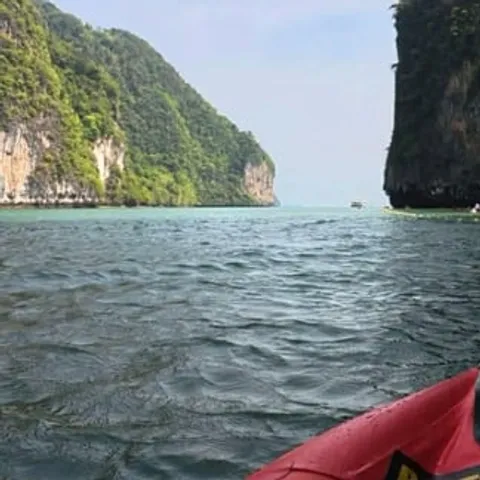
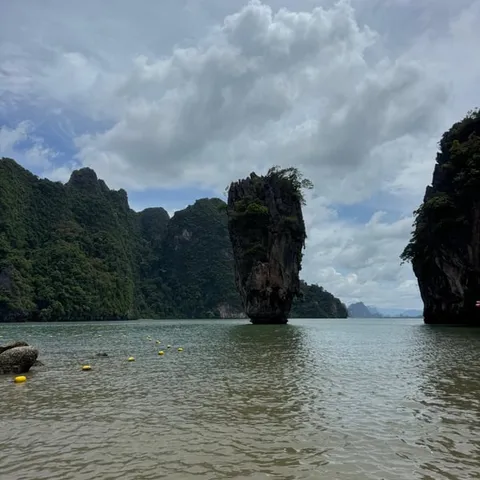
If you are planning a beach vacation, November to February are ideal. The weather is sunny and tropical; you can experience different festivals and immerse yourself in the culture.
Is a glowing-water night worth it?
Booking tips
- Pick a night close to the new moon
- Reserve now and pay later on the tour listing
- Set aside a whole evening, not just an hour
- Foreign adults pay a 300 baht park entrance fee[7]
What Makes the Sea at Night Glow
The glow on the water in Phang Nga Bay comes from living cells rather than from the sea itself. Bioluminescent plankton in Phuket and Phang Nga Bay are caused by dinoflagellates, microscopic single-celled organisms that emit blue-green light when disturbed, creating a glowing ocean effect best seen in dark, calm waters.[1] Those last two conditions decide whether you see anything at all. A bright moon, a lit pier or the deck lights of your own boat can wash the shimmer out long before your eyes have had a chance to adjust.
A dinoflagellate is far smaller than a grain of sand, and a single one of them would be invisible to you. What you notice instead is the combined output of a great many of them drifting in the same water you are paddling through. On its own, each cell produces only a faint spark. Packed together in a dense patch, they can turn one paddle stroke into a streak of cold blue light that hangs for a heartbeat and then fades away.
The light is a response rather than a lamp. It appears where the water is being moved, so a blade pulled through the surface, a hand trailed over the side or a small wave slapping a cave wall will each leave their own brief trail. Sit still and the bay turns black again. The whole experience comes down to what you and your paddle do once the sun has gone and the boats have headed home.
Why a Paddle Stroke Lights the Water
Bioluminescent plankton in Phang Nga Bay emit their blue-green light when they are disturbed.[1] The trigger is movement in the water around them, and it does not take much of it. The drag of a canoe hull, a swimmer's kick, a rope tapping the surface or the churn behind a slowly turning boat can all set the cells off. Nothing has to touch the plankton directly, because a pressure wave travelling through the water is enough to make the light appear along its path.
The glow tends to follow a pattern instead of appearing everywhere at once. Strokes light the water in lines. Wakes light it in curls that spread, brighten and vanish. Watch a single paddle blade on a dark night and you can see the light arrive a fraction of a second behind the movement, then fade as the surface settles back into black.
Inside the sheltered lagoons of Phang Nga Bay the effect is easier to follow, because the water there is calm between movements and there is little else to distract your eyes. A canoe drifting out of a cave passage can leave a long, soft trail behind it. In the open bay the same plankton may be present in equal numbers, but wind and chop spread the light out until it disappears into the dark.
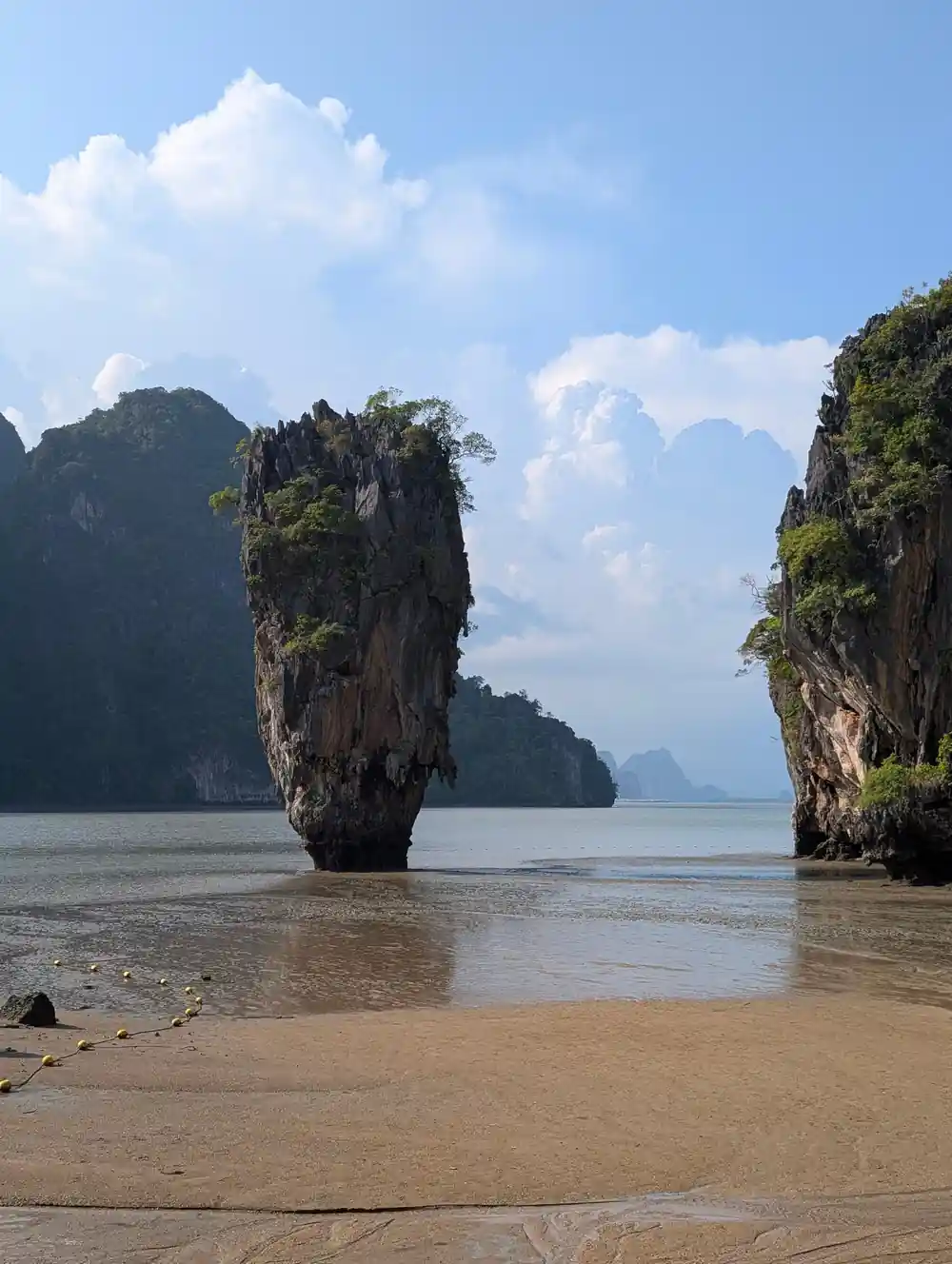
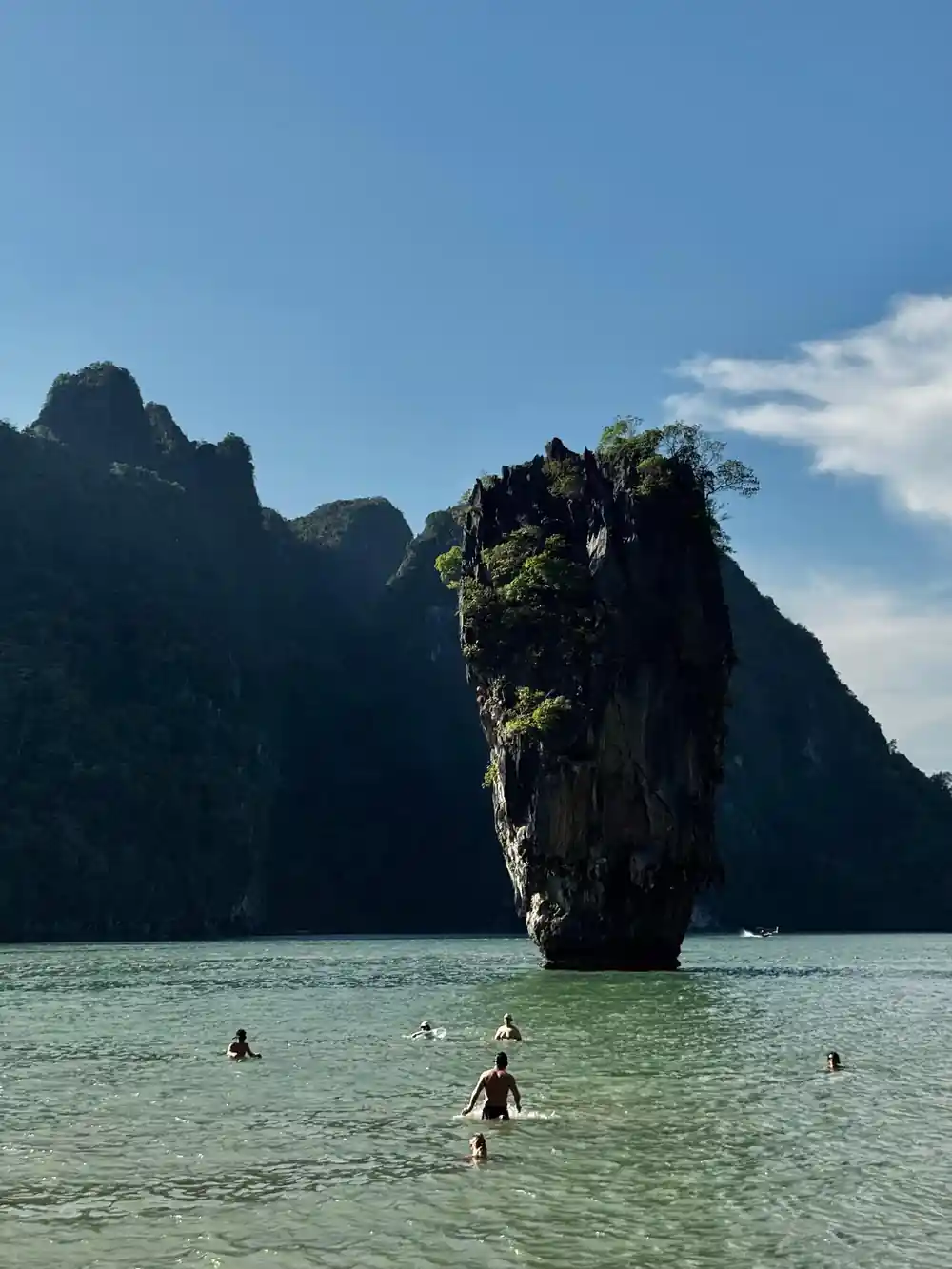
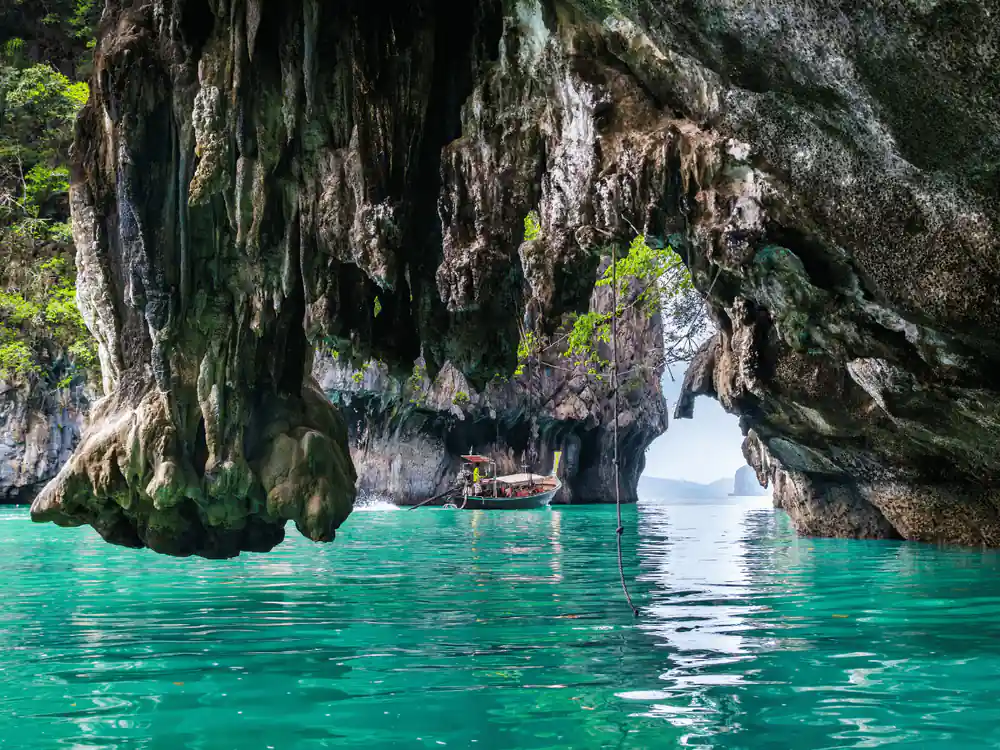
Limestone karsts and shallow turquoise water on the edge of Phang Nga Bay.
Dark Nights and Calm Water Matter Most
Darkness is the one condition worth planning around. The glow is faint, and a full moon, a lit pier or a string of anchored boats will dilute it, as will the lights on the vessel you are travelling in. Evenings with little moonlight, after the day boats have gone home, improve your chances of noticing the colour in the water at all.
Give your eyes time as well. Human eyes take a while to adapt to low light, and the difference between the first minute after the engine stops and the tenth is often the difference between seeing nothing and seeing a trail. Keep phone screens off, and look slightly to the side of the brightest patch of water rather than straight at it.
Calm water changes what you are able to see. Chop breaks the surface into countless small movements, each one lighting a little plankton and blurring the whole effect into a grey haze. On a still night the wake of a canoe stays legible, and a single stroke leaves a line you can follow with your eyes from the blade to the stern. On a breezy evening, a sheltered channel will still give you a better look than open water.
Red Tides Are a Different Kind of Bloom
Glowing water and red water are often mentioned in the same conversation, but they are not the same event. A red tide is a surface bloom that discolours the sea by day and can look alarming from a boat. The faint blue-green light you go looking for after dark is a different phenomenon, and it never announces itself in daylight.
That distinction matters when you are weighing up the conditions for a trip. Coloured water seen on a daytime crossing is not the same story as the glow after dark, and a clear, ordinary afternoon does not tell you much either. The moon phase is free to check, the wind forecast is easy to read, and both shape your evening far more than a water-quality report will.
from US$88
The bioluminescent plankton and sea canoe tour runs 8 hours, with pickup options and free cancellation up to 24 hours.[4]
Where the Glow Turns Up in Phang Nga Bay
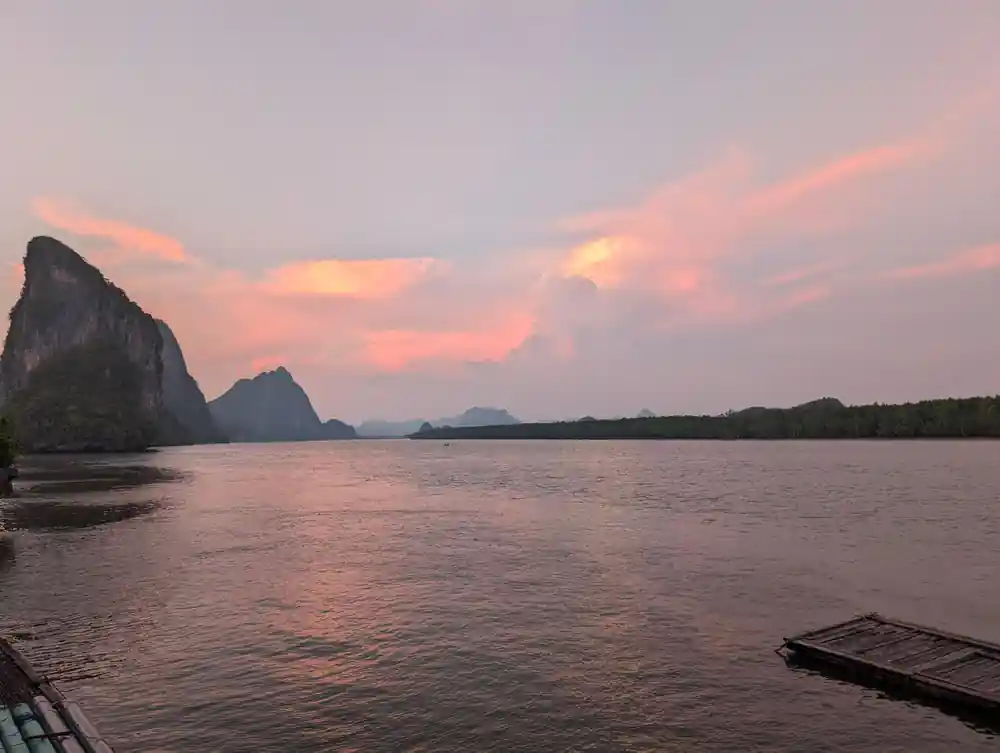
Ao Phang Nga National Park was established in 1981 and spans approximately 154 square miles (400 square kilometers).[9] Inside it, steep limestone karsts rise out of shallow green water, and mangrove forests fill the channels between the islands. Species growing along the Phang-Nga coast include Rhizophora apiculata and Avicennia alba, along with other mangrove trees that knit the shoreline into an almost impenetrable wall.[10]
The best-known stop along this coast is James Bond Island, officially Ko Tapu, the limestone spire on the twin-peaked islet of Khao Phing Kan, which was made world-famous by the 1974 film The Man with the Golden Gun.[11] Close by, Koh Panyee is a floating village built entirely on stilts by Indonesian fishermen, sitting at the foot of a towering limestone cliff.[12] Night trips travel the same water, but by then the tour boats have gone.
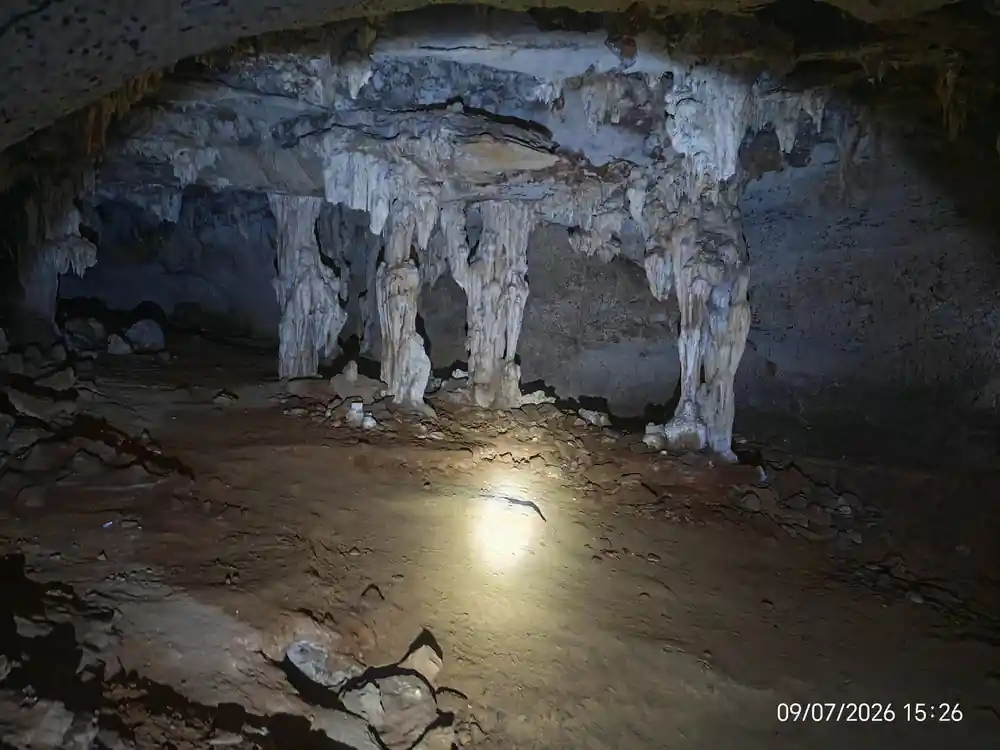
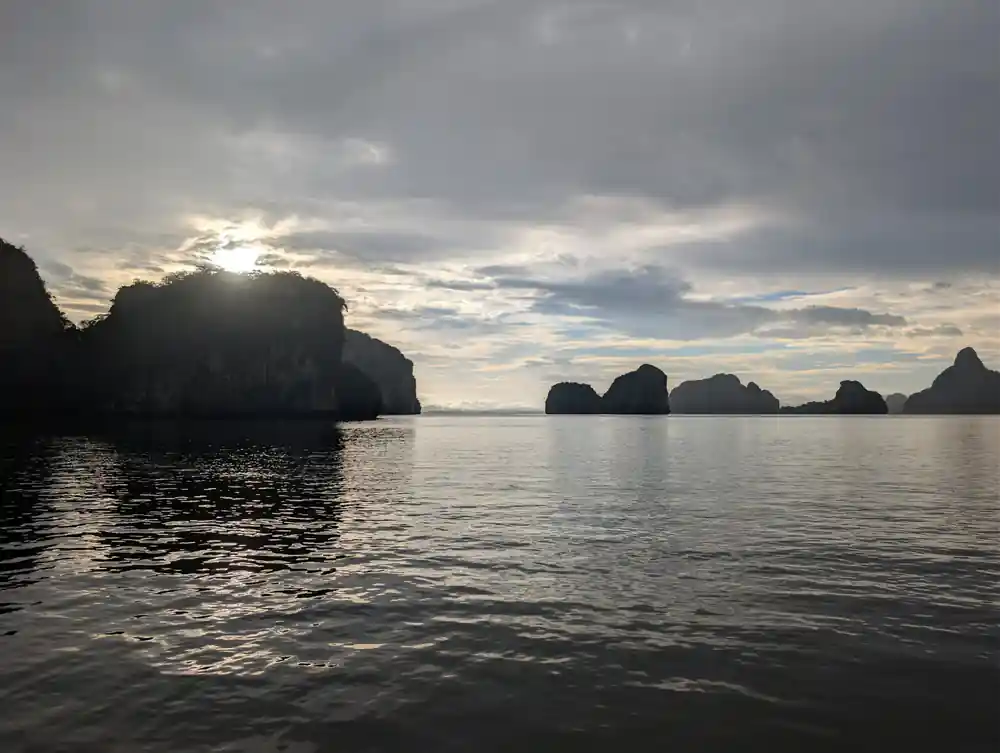
The geology is what makes this coast so well suited to a dark paddle. A hong is an enclosed lagoon inside a limestone cliff, and the way in is to lie flat in a kayak and paddle through a dark, narrow cave passage that opens into the hidden space beyond.[2] Once you are inside, rock surrounds you on every side, the wind drops away and the lights of Phuket are out of sight. Some night kayak tours in Phang Nga Bay include a sunset paddle under the evening sky, with bioluminescent plankton glowing in the water.[13]
What the Glow Actually Looks Like
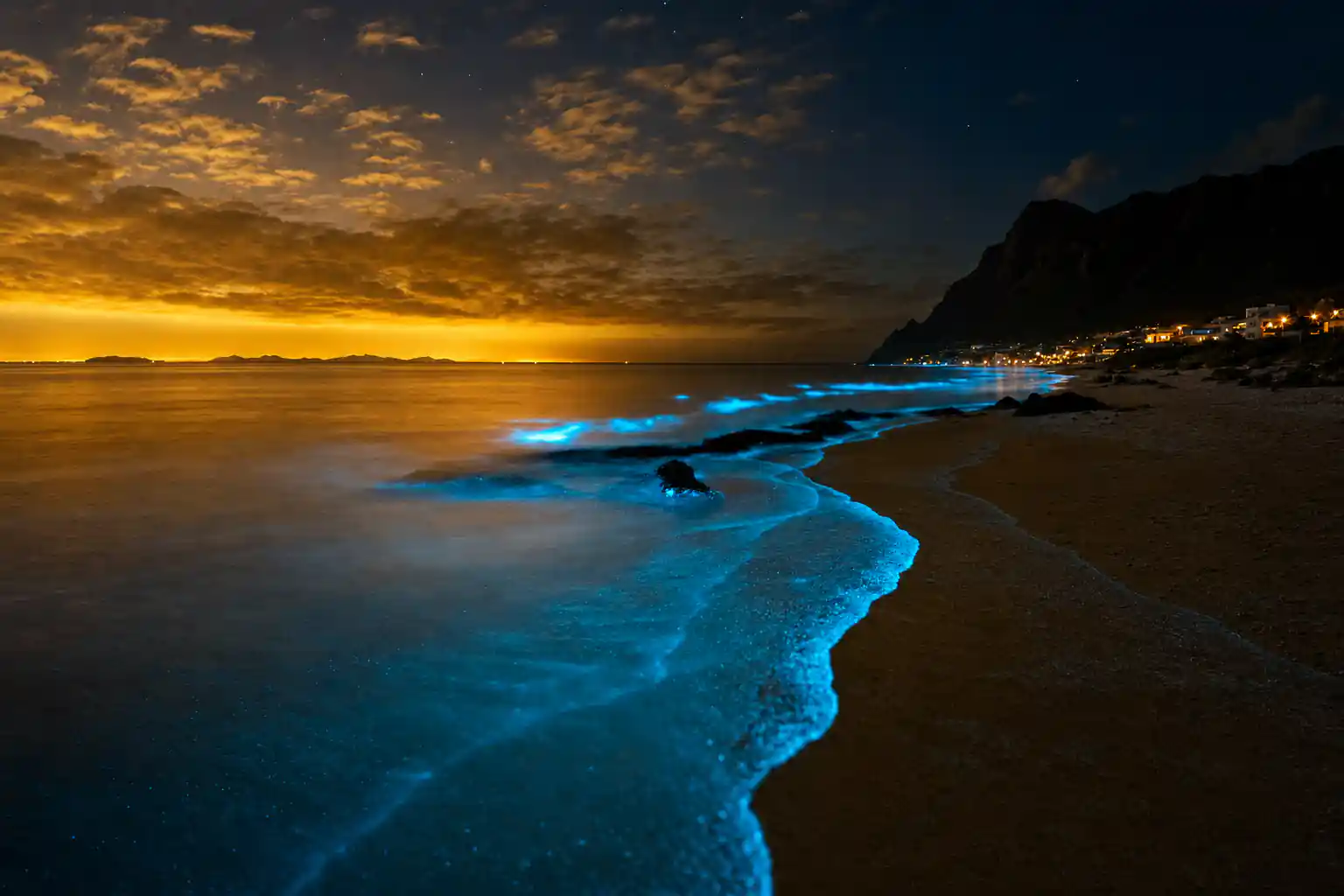
Anyone hoping for a glowing beach will find something subtler. The light is usually a pale blue-green, closer to a glow stick than to neon, and it appears in streaks, dots and swirling trails rather than as a uniform shine across the bay. Where the plankton are dense, a single stroke can flare along the whole length of the blade. Where they are sparse, you may catch only a few faint pinpricks near the canoe.
The light is triggered by movement, and the way you paddle changes what you see. A stroke pulled slowly through the water leaves a line behind the blade. A splash throws out a scatter of dots that fades as they fall. Trailing a hand over the side of the canoe puts the glow at your fingertips. Sitting still between strokes lets the trail die away and gives you a clean, black surface to draw on again.
Cameras struggle with light this dim, and a bright phone screen will undo whatever night vision you have built up. If you want a photograph, a tripod and a long exposure are the usual answer, and many travellers decide the memory of a glowing wake is better than anything they manage to capture. Put the camera away for a few minutes and the water will show you more.
Planning Your Night on the Water
November to February is the ideal window for a beach vacation in Phang Nga Bay, when the weather is sunny and tropical.[3] For the glow itself, the darkness of the night you choose matters more than the month. Ao Phang Nga National Park is a Category 3 national park, and foreign adults pay an entrance fee of 300 baht.[7] Alcohol is not allowed in Thailand's national parks, so leave the drinks on shore.[8]
For the boat, wear something that can get wet and bring a dry bag for your phone, a light long-sleeved layer for the ride back and shoes you do not mind soaking. Mosquito repellent is worth having for the pier, and a small towel is a kindness on the return journey. You will spend much of the evening sitting low in a canoe, so keep whatever you carry small and waterproof.
The Phang Nga Bay bioluminescent plankton and sea canoe tour runs 8 hours from US$88, with pickup options and a live guide in English, Spanish and German.[4] Reserve now and pay later, and free cancellation is available up to 24 hours in advance.[4] Starting times vary by date and pickup point, so check availability before you commit to an evening.[4]
From prices for Phang Nga Bay canoe and plankton tours
From prices in US dollars for the big boat tour[6], the 7 Wonders 6-islands tour[14], the bioluminescent sea canoes tour[4] and the twilight plankton tour[5].
What a Phang Nga Bay canoe tour costs
From prices in US dollars for the bioluminescent sea canoes tour[4], the twilight tour[5], the big boat tour[6] and the 7 Wonders 6-islands tour[14]. Child amounts repeat the listed price; no child rate.
When to be on the water
How the glow happens
Plankton sit in the water
Dinoflagellates drift in the bay all year, far too small to see in daylight.[1]
The sun goes down
Once daylight fades, the faint blue-green the plankton make is no longer competing with the sun.
Something moves the water
A paddle, a hand or a rolling wave disturbs the cells, and each one flashes in reply.[1]
The flash fades fast
The light is brief, so it follows your movement and disappears as soon as the water is still again.
You try again in a hong
Enclosed lagoons reached through narrow cave passages stay calm and dark, which suits a second attempt.[2]
Ready to see the water light up after dark?
from US$89Reserve now & pay later